

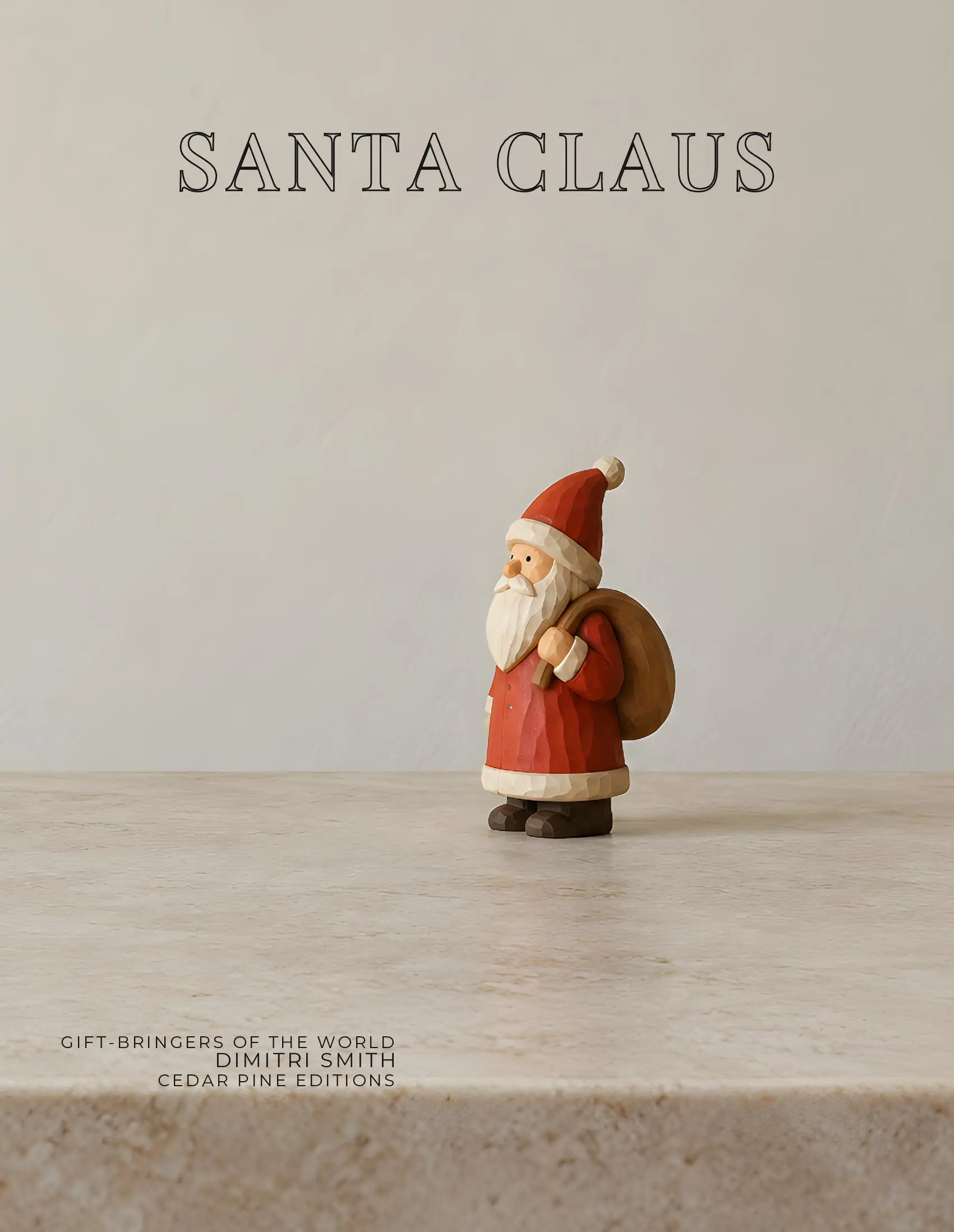
Description
Coffee Table Book of: Santa Claus is a large-format coffee table book about Santa Claus and the gift-bringers of Christmas, printed edge to edge in colour, one picture to a page and the widest carried across two. The gift-bringers, from Saint Nicholas to Joulupukki, appear as small carved, moulded and painted figures.
It opens with Saint Nicholas: a carved bishop in a red cope and a gold mitre, an old figure with a small barrel at his feet, and a golden brioche baked as a little bishop.
Then Santa Claus in America: a stout Dutch sailor with a pipe, a red toy sleigh drawn by a single reindeer, a sleigh of parcels behind a team of reindeer, a red suit with a wide black belt, a Santa carved from an old fence post, and Mrs Claus with a basket on her arm.
Then Santa in many materials: chalkware, unglazed bisque, a cast iron money box, a wind-up tin toy with its key, a little Santa on a cake in white royal icing, a tin cutter beside biscuits cut in his shape, whittled pine, wood chip-carved in small triangles, and a hooked rug.
Then Sinterklaas in a red cape and tall red mitre, a little tin steamboat and a white wooden horse. Then Germany: the Belsnickel in a ragged fur coat with a bundle of twigs, Knecht Ruprecht in a black hooded robe sewn with little bells, and the Weihnachtsmann with a sack of presents.
Then Russia: Ded Moroz in a heel-length blue coat, white felt boots embroidered with red flowers, a toy troika and the Snow Maiden in pale blue.
Then Pere Noel with a basket on his back, Babbo Natale, a golden New Year bread set with almonds, Saint Basil, and milk and biscuits on a summer veranda. Then the sleigh: an old red sleigh in a snowy field, the curled front of an iron-shod runner, and a model sleigh shaped as a white swan.
Then the workshop and the grotto: an open toy box, a shelf of wooden toys, a miniature workbench with a half-built doll’s house, an empty grotto hung with icicles, and a red coat and cap on a peg.
Short notes run through the book. They are about the gift-bringers, their names and their customs, rather than about the pictures: how an 1889 poem gave Mrs Claus a voice of her own, where the Belsnickel comes from and where he lives on, why an effigy of Pere Noel was burned at Dijon in 1951, and how the traditions of Europe’s gift-bringers have long borrowed from one another.
Printed in full colour on heavy 150gsm coated paper at 216 x 279 mm (8.5 x 11 inches), as a paperback.


Reviews
There are no reviews yet.