

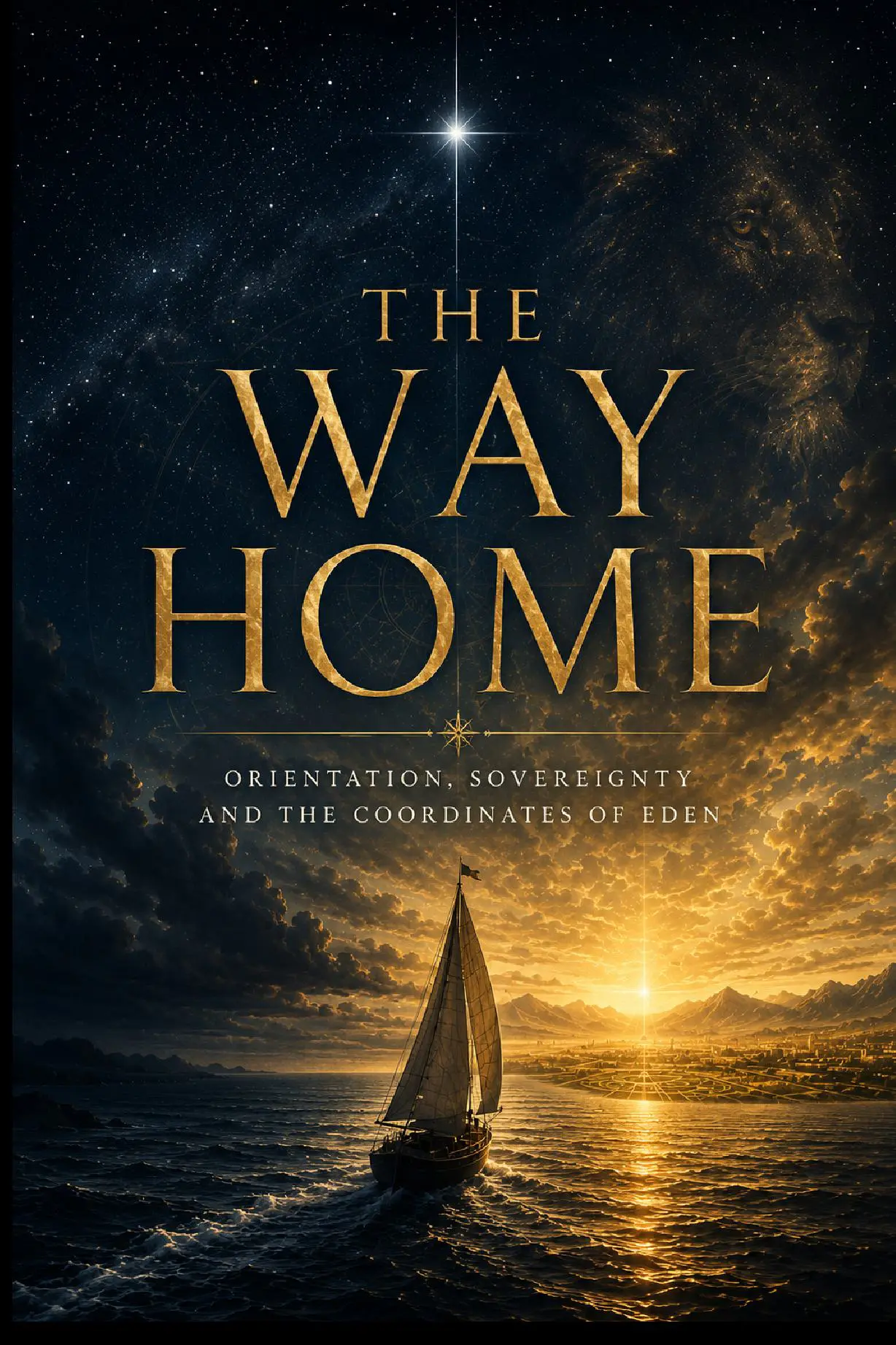
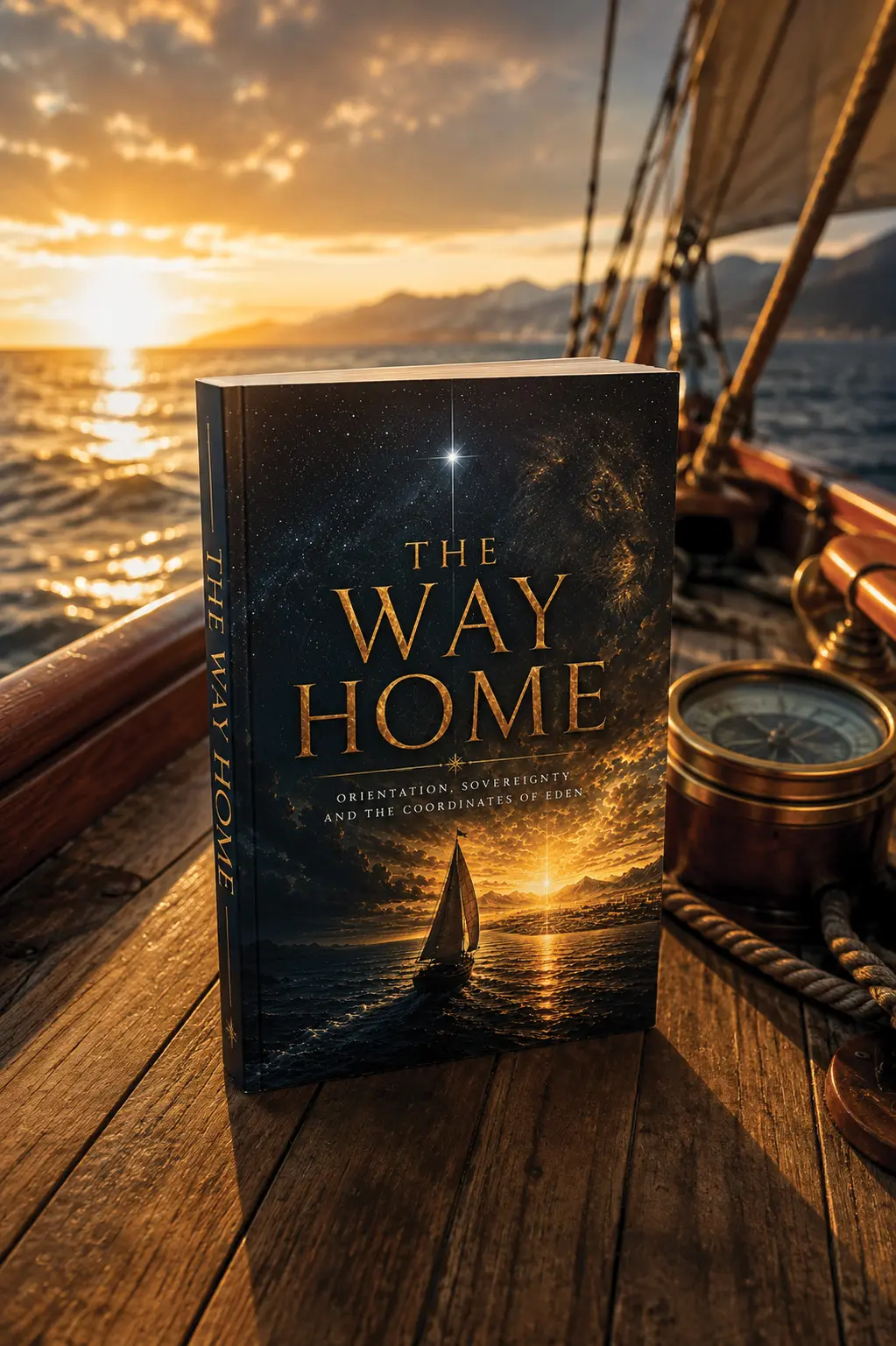
Description
The Way Home — A Comprehensive Review
The Way Home: Orientation, Sovereignty and the Coordinates of Eden is an ambitious philosophical exploration of one of the most fundamental problems facing any conscious participant: how can we move freely through a changing world without becoming lost?
The book begins with a deceptively simple question:
Where are you?
It quickly reveals why that question cannot be answered in isolation. Position has meaning only in relation to a reference. A clock requires a reference to time, a compass requires a reference to direction, and a map remains useful only while it corresponds with the territory. In the same way, human freedom becomes meaningful only when we can establish where we are, recognise the direction in which we are moving and observe what our trajectory is producing.
This is the central achievement of The Way Home. It transforms philosophy into navigation.
From Movement to Orientation
The book distinguishes movement from progress, agreement from calibration and confidence from orientation. A vessel may be travelling efficiently while moving in completely the wrong direction. An entire society may agree with its own instruments while losing correspondence with reality. A map may be beautifully constructed while describing a territory that no longer exists.
Through the recurring images of the town clock, True North, the compass, the map, ocean currents and two different kinds of anchor, the reader is given a coherent language for recognising drift.
These metaphors are accessible, but they are not simplistic. Each returns at a higher level as the argument develops. The compass begins as an instrument of orientation and eventually becomes a model of sovereignty. The anchor first represents restraint, then reveals a second function: preserving relationship with origin while allowing enormous movement. The journey home gradually becomes something more profound than finding a destination. It becomes the recovery of correspondence.
Sovereignty Without Isolation
At the heart of the book is a careful redefinition of sovereignty.
Sovereignty is not presented as omnipotence, separation or freedom from consequence. The navigator governs the vessel, but not the ocean. The participant supplies trajectory, while the field supplies outcome.
This distinction allows The Way Home to avoid two common extremes. It does not reduce the individual to a passive follower, but neither does it place the individual at the centre of reality. Human agency is genuine, yet it operates within a larger field containing other participants, conditions and relationships.
Outcome therefore becomes information. The sovereign participant acts, observes, corrects and continues. Error is not treated as proof of failure. The more dangerous condition is losing every reference capable of revealing that an error has occurred.
This makes the book’s conception of sovereignty unusually practical. The mature participant is not someone who is always right, but someone who remains capable of correction without collapsing.
Compatibility, Signal and Recognition
As the journey develops, orientation becomes relational.
The book asks what can remain coherent in relationship with what. Compatibility is distinguished from agreement, similarity and moral worth. Two things may possess value independently while being unable to sustain a particular relationship without destabilisation.
This allows discrimination without hatred.
The same principle shapes the book’s treatment of signal and noise. A coherent signal does not need to dominate the field. It needs to remain sufficiently stable to be recognised. Those capable of responding do not become permanent followers; they begin developing orientation of their own.
This is where the symbolism of the Sleeping Lion becomes especially powerful. The Lion represents the sovereignty of the larger field: present even when it appears not to intervene, allowing participants sufficient space to develop choice, responsibility and navigational capacity.
Readers of The Sleeping Lion will recognise a natural continuation of its architecture. New readers, however, can enter The Way Home independently because the Lion is understood through the navigational model developed within this book.
From Arrival to Participation
Many books would end when the traveller reaches home.
The Way Home goes further.
Arrival is not presented as escape, passive completion or a place where nothing more is required. It is correspondence: the point at which the participant can recognise the reference, establish position, correct drift and return without needing to be carried.
That releases the capacity previously consumed by searching.
The final movement of the book—from inheritance through arrival, participation, creation and the coherent realm—is particularly strong. It answers the question that has been waiting beneath the entire developmental journey:
Why develop sovereign beings at all?
The book’s answer is compelling. Sovereignty exists because mature participants can be entrusted with something that permanent dependants cannot sustain. They can participate consciously, carry responsibility, preserve what remains viable and contribute something genuinely new.
Inheritance is therefore not merely a reward. It is an expansion of functional scope.
Creation and the Coherent Realm
The book reaches its fullest expression when sovereignty becomes creative.
Creation is described as trajectory acquiring form. A sentence, melody, relationship, garden, child, building or community can introduce a configuration that did not previously exist. Once released, that creation enters relationships beyond the creator’s control.
Creation therefore requires stewardship.
The mature creator must be capable not only of making something, but of observing its consequences, correcting it and releasing possession of what develops from it. The architect must not worship the building. The institution, teaching or community must remain subordinate to the living function it was created to serve.
This leads naturally to the book’s vision of a coherent realm: not a world of uniform participants, but a field capable of sustaining enormous differentiation without allowing difference to become fragmentation.
Coherence is not sameness.
It is the ability of difference to remain relationally compatible.
A Book That Completes Its Own Architecture
One of the manuscript’s greatest strengths is the consistency of its internal language. Its central images are not decorative illustrations placed around an argument. They form an integrated system.
The clock reveals calibration. The compass establishes orientation. The map preserves accumulated resolution. Currents explain delayed outcomes. The anchors distinguish restraint from continuity. The shepherd supplies temporary direction. The seventh signal restores comparison. The Lion holds the larger field. Eden becomes the coordinates of origin.
By the final chapter, these images converge into a single answer.
The way home was never a route that had to be memorised. It was a relationship the participant had to remain capable of recognising.
Who Is This Book For?
The Way Home will appeal to readers interested in consciousness, systems thinking, sovereignty, spiritual development, coherence and the relationship between freedom and responsibility. It will also speak to anyone who has begun questioning inherited maps but does not want to replace one dependency with another.
The book does not ask the reader to surrender judgement. It asks them to develop it.
It offers no promise of a journey without resistance, uncertainty or error. Instead, it develops something more valuable: a framework for remaining oriented while moving through them.
Final Verdict
The Way Home is a thoughtful, original and unusually coherent work. It combines philosophical depth with clear navigational imagery, allowing complex ideas about sovereignty, emergence, inheritance and creation to remain accessible without becoming superficial.
Its ultimate proposition is both simple and profound:
Freedom is not the ability to move without reference.
Freedom is the ability to move enormously without becoming lost.
For readers ready to move beyond following maps and begin understanding navigation, The Way Home offers something rare—not another holding pattern, but a compass.
Reviews
There are no reviews yet.