

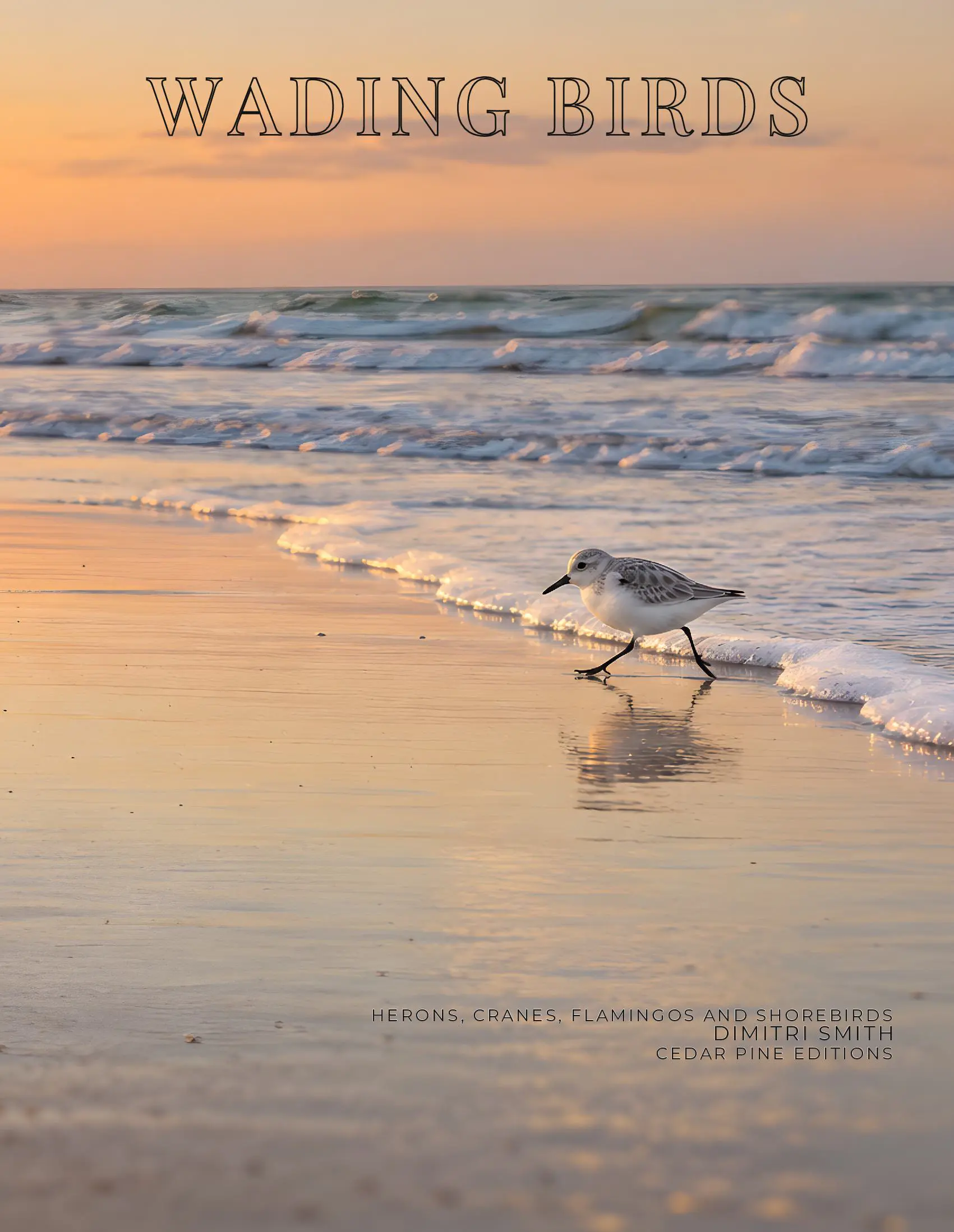
Description
Coffee Table Book of: Wading Birds is a large format book of wading birds, printed edge to edge in colour, one picture to a page and the widest carried across two: herons and egrets, cranes, storks, spoonbills, ibises, flamingos and the small shorebirds of beach and mudflat, standing, wading and in flight, their faces and feathers seen close, their nests, eggs and young, and the wetlands where they live, at many hours and in every season.
A grey heron holds a small silver fish crosswise in its bill and flies low over a misty river, a great blue heron stands at the edge of a marsh at dawn and waits on its nest in a flooded swamp, a black crowned night heron perches over dark water at dusk, a purple heron hides among green reeds, a green heron crouches on a mossy log and a bittern points its bill at the sky among golden reeds.
A red crowned crane stands in deep snow, a common crane calls in a misty marsh and leaps in a frosted meadow, a grey crowned crane perches in a thorn tree, demoiselle cranes fly high in an autumn sky, a crane flies beside its brown young, sarus cranes stand in a flooded field and a whooping crane walks through a salt marsh.
A roseate spoonbill sweeps its bill through a lagoon, two white spoonbills fly low at sunset and a white chick sits in its nest of reeds. A scarlet ibis perches on a mangrove branch, and glossy, sacred and white ibises wade the meadows and probe the mud.
Seen close are the heads of a grey heron, a great egret, a wood stork, a spoonbill, a white ibis, a flamingo, a ruff, an oystercatcher and a sandhill crane, with heron and flamingo feathers, nests, eggs, chicks and tracks in wet sand.
Short notes run through the book, on how wading birds feed, fly and call, how they nest and raise their young, and the record holders among them: in the breeding season the bare skin between a great egret’s eye and bill turns a vivid green, what looks like a red crowned crane’s black tail is really the black feathers of its folded wings, the greater flamingo is the largest flamingo, and like its kin often rests standing on one leg, and in summer the dunlin wears a large black patch on its belly, which few other small waders share.
Printed in full colour on heavy 150gsm coated paper at 216 x 279 mm (8.5 x 11 inches), as a paperback.





Reviews
There are no reviews yet.