

Description
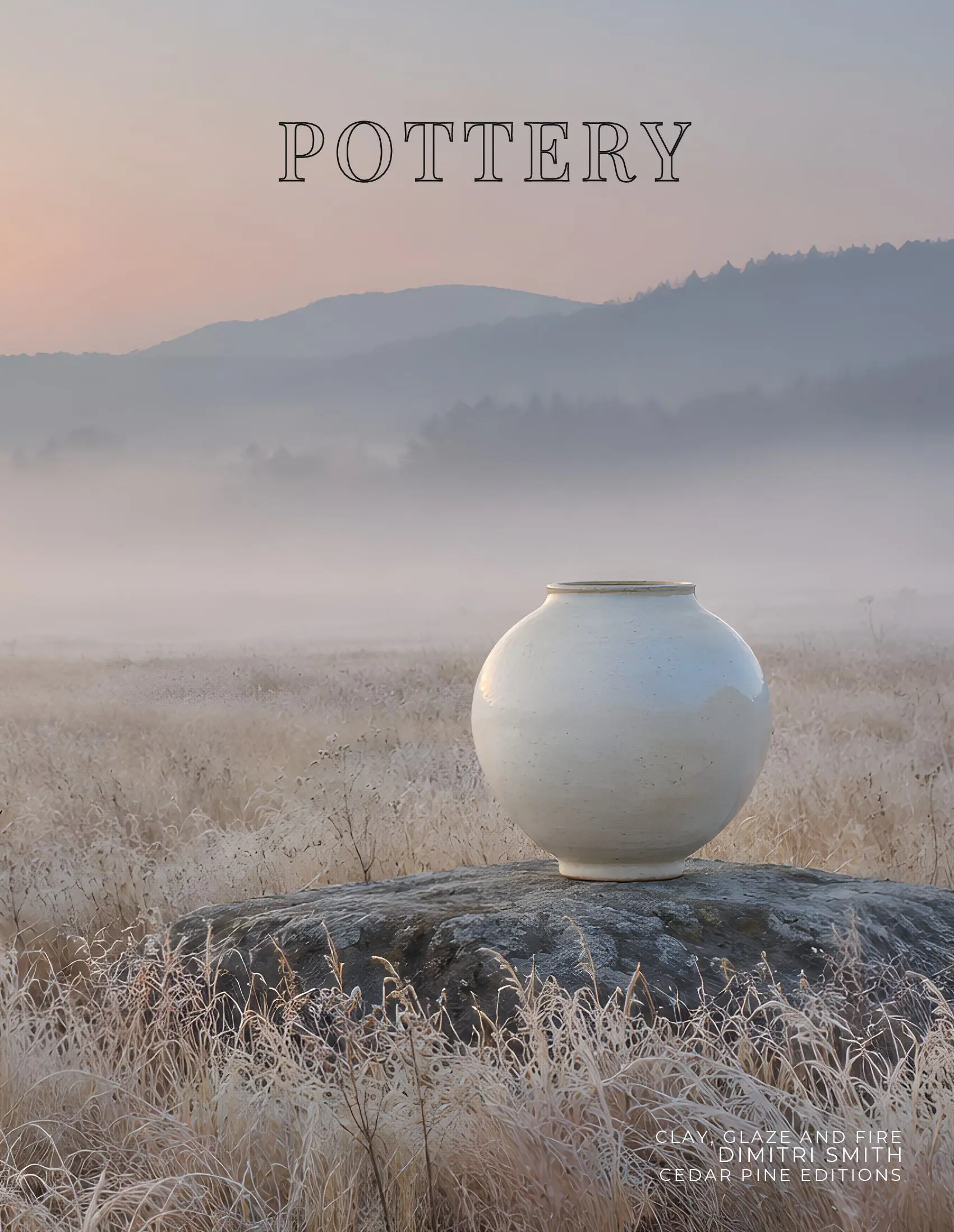
Coffee Table Book of: Pottery is a large format book about pottery, printed edge to edge in colour, one picture to a page and the widest carried across two: pots standing alone on stone, slate, linen and bare boards, the workshop and its tools, kilns of brick and steel by day and by night, and the fire, ash and smoke that finish the work.
The making comes first: a heap of freshly dug clay streaked with rust, a block of wedged clay folded like a shell, a dome of wet clay centred on the wheel, a freshly thrown bowl ringed inside, beakers drying in a row, a bowl turned over to show its trimmed foot, an old kick wheel in a whitewashed room, a wooden rib, a cutting wire, test tiles in a row and cups in dull chalky coats of raw glaze.
Stoneware follows in iron, ash, salt and soda: a bottle vase breaking to rust at the rim, a lidded jar flecked with iron, a creamy jug with a pinched lip, a tall jar running with green ash, a vase blushed by the kiln, a jug pitted like orange peel and a milky tea bowl full of pinholes.
Raku pots glow in burning sawdust, crackle in black, flash copper, gold and turquoise and carry the fine black lines of burnt horsehair. Celadon bowls, jars and vases show soft jade greens, deeper in every carved groove, beside porcelain glowing with daylight through its walls, a block of white kaolin, a jar painted in cobalt blue, a tea bowl mended with seams of gold, and tin glazed dishes, jugs and tiles painted in blue, yellow, orange and green.
Slip and glaze run through the rest: a dish trailed with cream slip, a vase scratched through to pale clay, a marbled bowl, silvery crystals in a pale blue glaze, a bottle vase in deep copper red, a crawled white glaze, an oil spot tea bowl and a sky blue bowl splashed with purple.
Short notes run through the book, on how clay is shaped, glazed and fired, the chemistry behind the colours, and the kilns and wares of the craft: throwing draws soft clay up and out on the spinning wheel and leaves fine spiral throwing rings inside, in raku, smoke from the burning sawdust seeps into fine cracks in the cooling glaze and stains them black, porcelain is fired so hot that its body partly turns to glass, and where it is thin, light shines through, and burnishing, rubbing leather hard clay with a smooth stone before firing, gives a soft shine with no glaze.
Printed in full colour on heavy 150gsm coated paper at 216 x 279 mm (8.5 x 11 inches), as a hardcover with the art printed on the case.





Reviews
There are no reviews yet.