

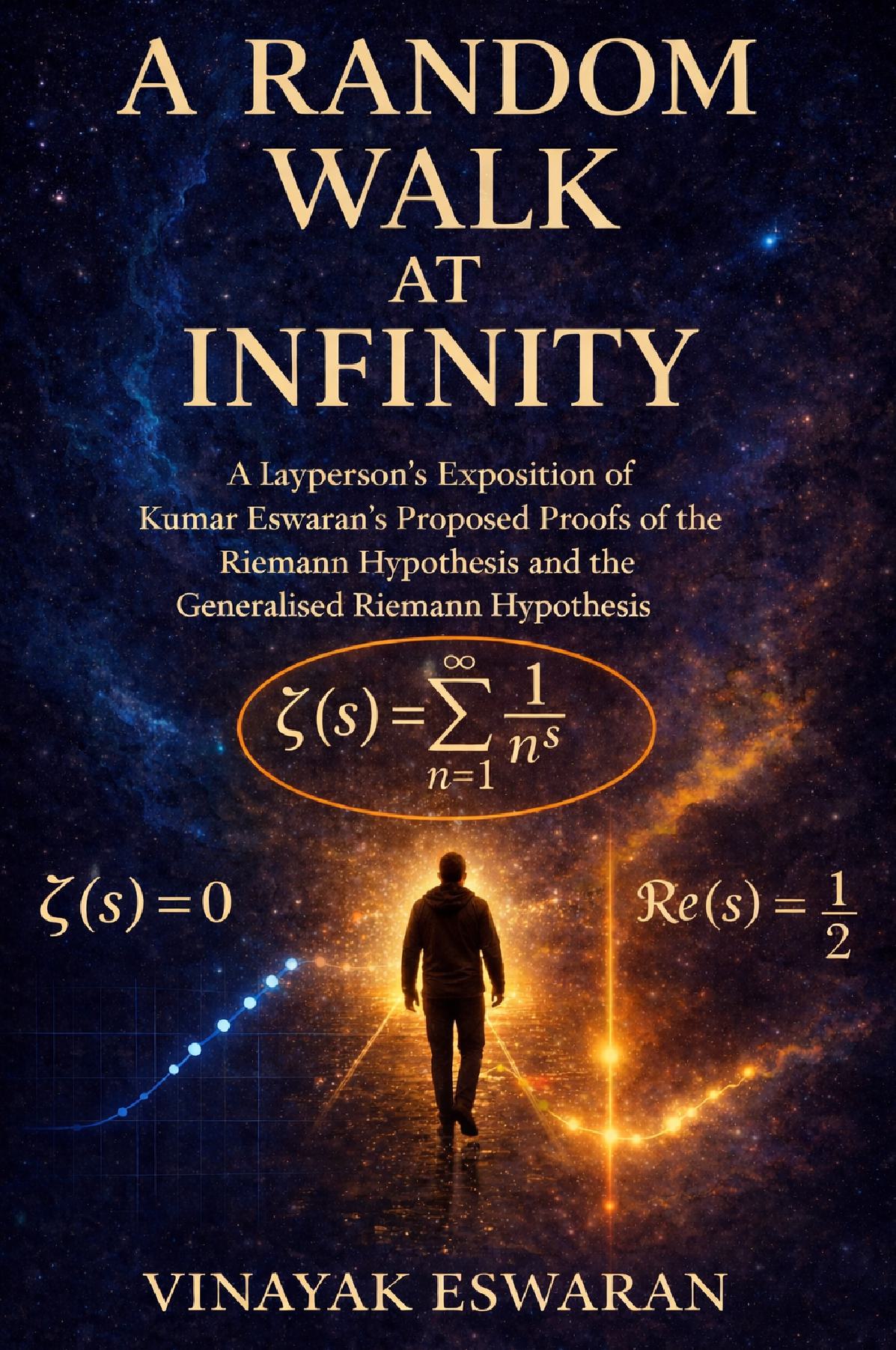
Description
This book presents the problem of the Riemann Hypothesis (and later the Generalised Riemann Hypothesis). It details the relevant developments from the work of Riemann (1859) to Littlewood (1912) and gives the comprehensive proofs proposed by Kumar Eswaran (2016-18) that use the probabilistic Law of the Iterated Logarithm of A.Y.Khinchin and A.N.Kolmogorov from the 1920’s. No mathematics discovered after 1930 is used in the proofs.
The book assumes no prior knowledge of the Riemann Hypothesis, or even advanced complex analysis. Starting from first principles, and free of jargon and abstract notation, the book can be read by undergraduate students of any mathematical discipline of science and engineering.
While its tone and language are directed at STEM educated laypersons, the book contains the detailed complete proofs. So mathematicians, scientists and graduate students are invited to read the book and critique the proofs (after reading, at least, Chapters 5 to 12 in their entirety).
The implications of the simultaneous proof of these two problems, considered to be the greatest in Pure Mathematics, are staggering in ways totally unanticipated. Foremost among these is that, contrary to universal expectation, the proofs say nothing at all new about prime numbers. Further, they question the foundational promise and future prospects of Analytic Number theory.
The author, Kumar Eswaran’s younger brother, who had followed his proof from its inception, has presented it here without dilution and all its antecedent history so that it can be understood by undergraduates. It is likely to be the most interesting book on higher mathematics you have ever read.




Reviews
There are no reviews yet.