

Description
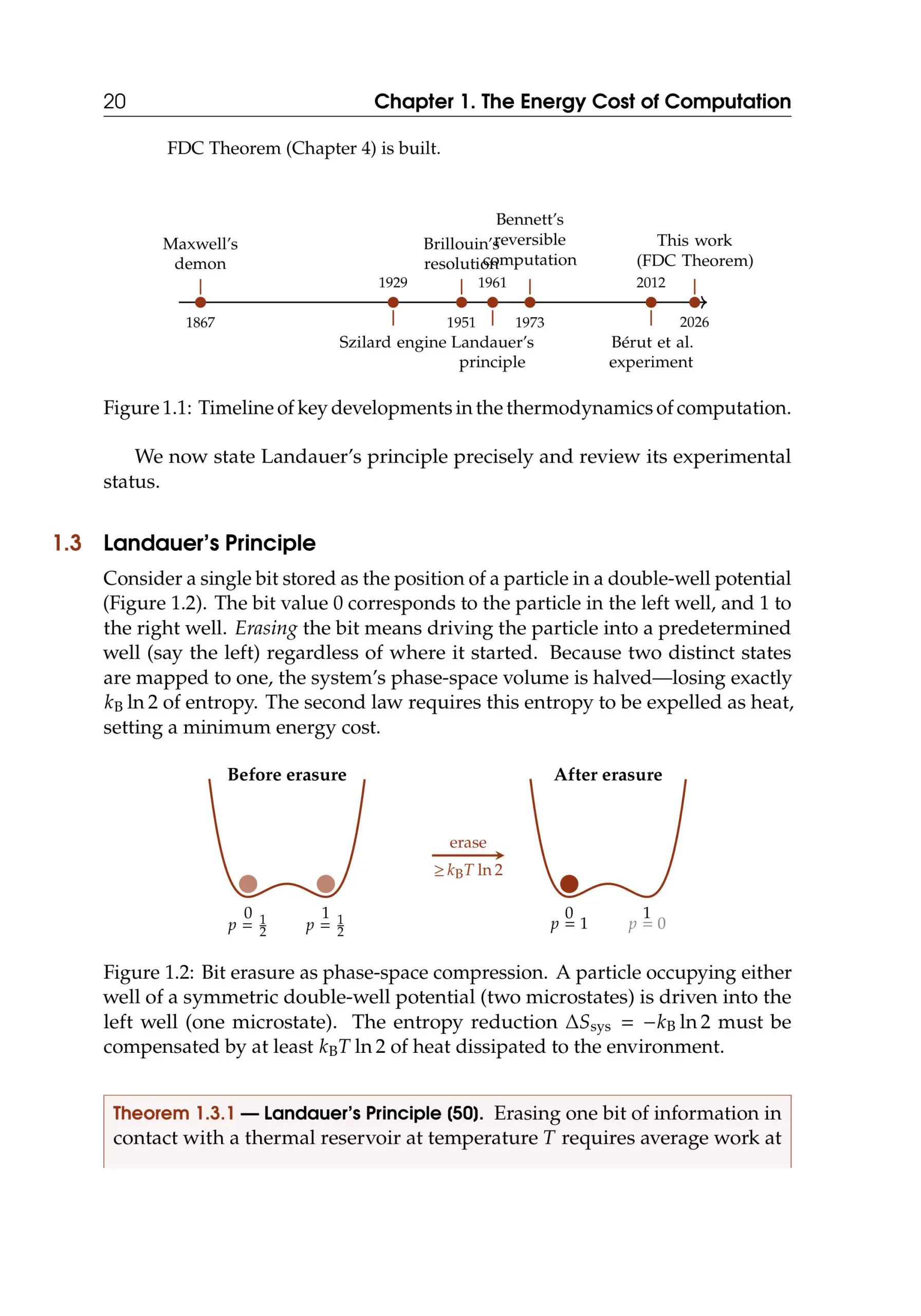
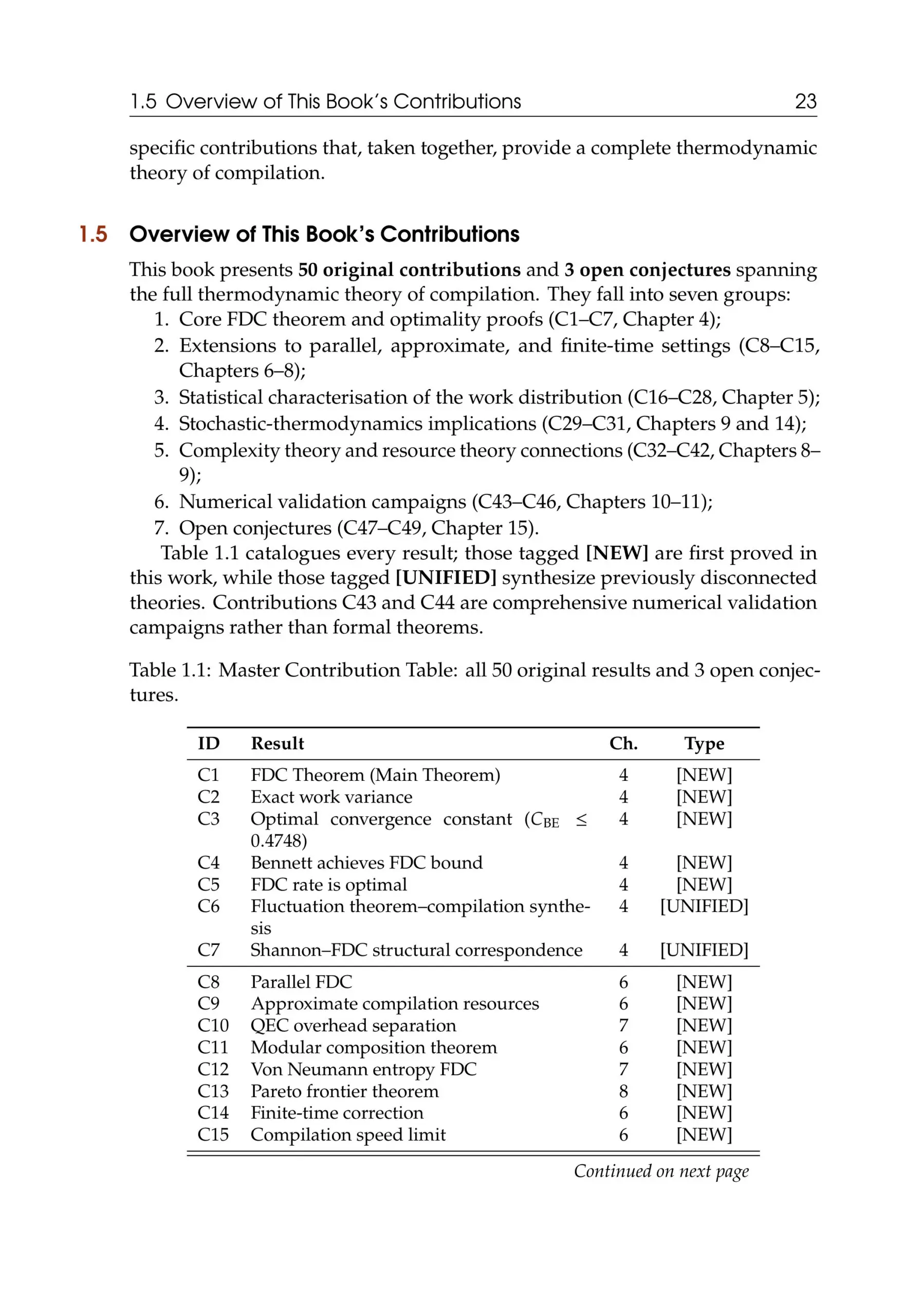
Every computation has a thermodynamic price. Landauer’s principle sets the floor: erasing one bit costs at least k_B T ln 2 of energy. But how fast can a real compiler reach that floor, and what are the unavoidable fluctuations along the way? This book answers both questions with a single result — the Fluctuation-Dissipation Compilation (FDC) Theorem — and develops the full theory around it.
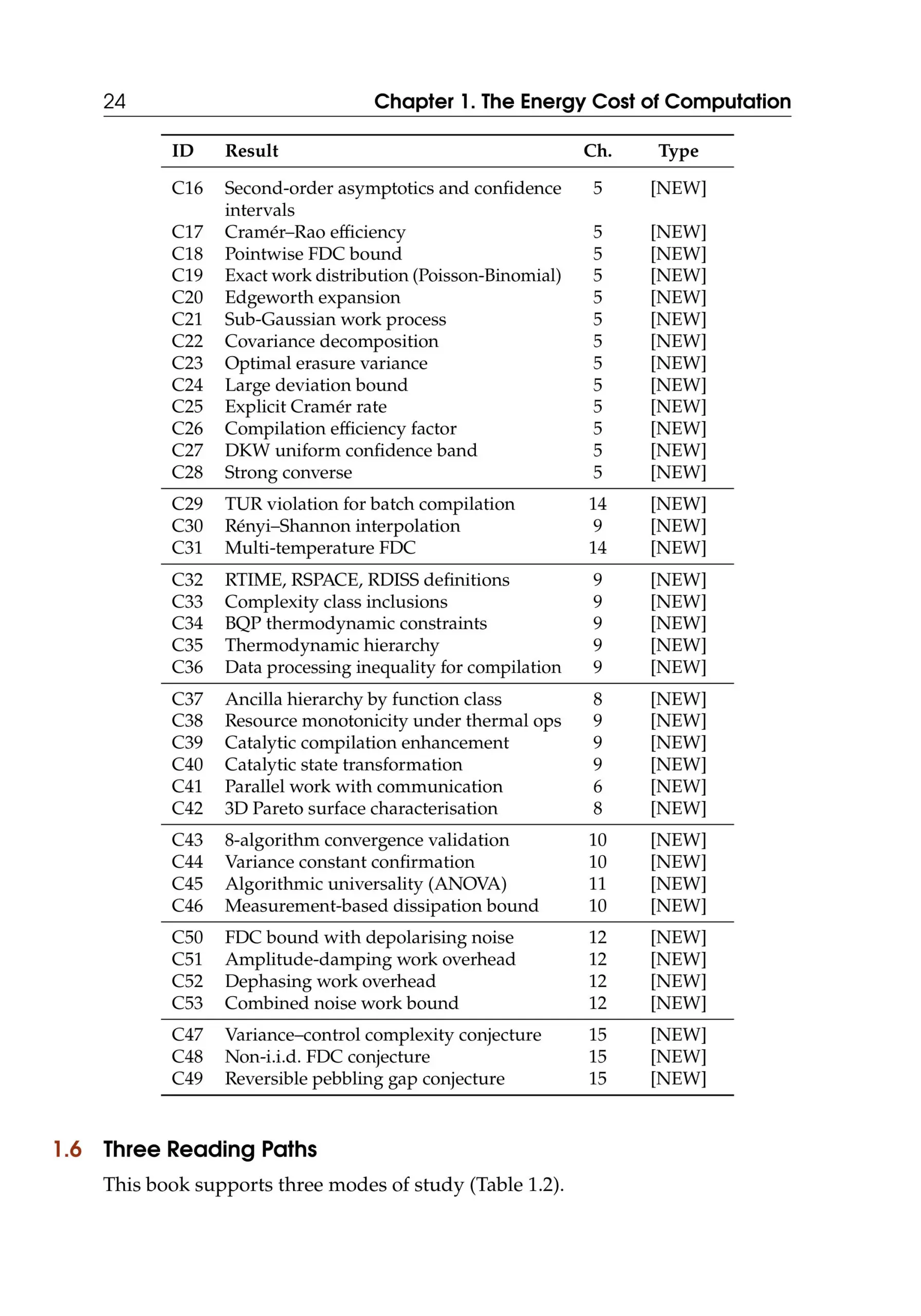
The FDC Theorem proves that reversible compilation converges to the Landauer limit at rate O(1/√N) with explicit, computable constants. Around this central result the book builds extensions to parallel, modular, approximate, and fault-tolerant settings; tight concentration inequalities and large-deviation bounds; new thermodynamic complexity classes (RTIME, RSPACE, RDISS); a resource-theoretic perspective; and end-to-end computational and experimental validation.
Part I (Foundations) develops the physical and computational prerequisites from the ground up: the energy cost of computation, fluctuation theorems and statistical mechanics, and Bennett’s reversible computation. Part II states and proves the FDC Theorem with its concentration and distributional consequences. Part III extends the framework to parallel, modular, approximate, and fault-tolerant compilation; Pareto-optimal work–time–space trade-offs; and thermodynamic complexity classes with a resource-theoretic perspective. Part IV validates the theory through simulation algorithms and experimental implementation. Parts V–VII explore broader implications, structural correspondences, and open problems.
Written for physicists, computer scientists, and engineers, the book offers three reading paths — Theorist, Engineer, Student — so readers can navigate the material from any starting point. Ten appendices provide complete proofs, simulation details, experimental protocols, statistical methods, and solutions to all 75 exercises.






Reviews
There are no reviews yet.